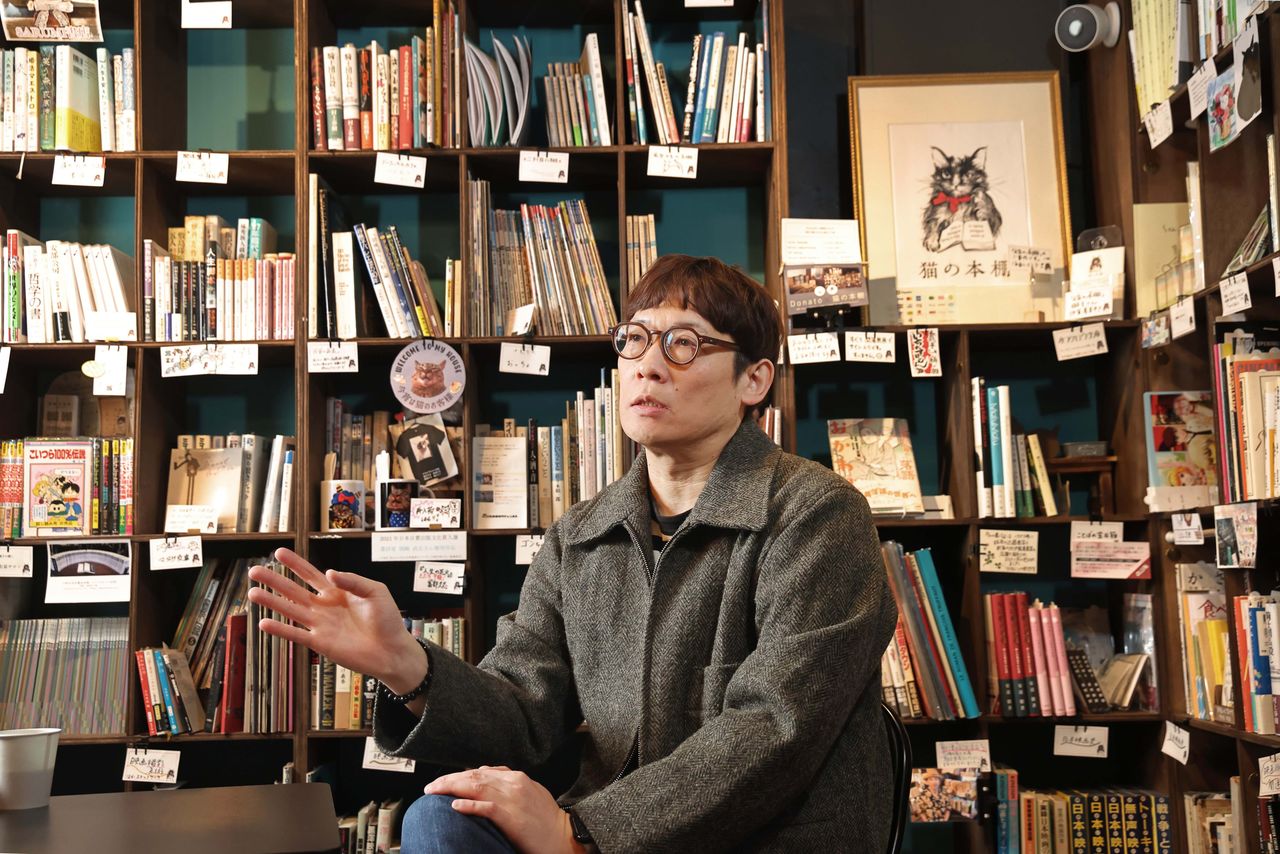
More than ten years after it was published in Japanese, Yagisawa Satoshi’s Days at the Morisaki bookstore it has reached worldwide attention with Italian and English translations. In this interview, Yagisawa discusses how the road to becoming an internationally successful author was not easy.
Online Readers
In January 2026, Yagisawa Satoshi visited India for the first time to participate in the Chennai International Book Fair and the Kerala Literature Festival in Kozhikode, which is known as the biggest literature festival in Asia. Between these two events, he also gave a talk at a bookstore in Bengaluru, so 10 days were filled in three cities in southern India. Hundreds of supporters lined up to get him to sign their books.
Yagisawa says: “I was amazed at how eager Indians were to read. At first, they read English translations, but recently there have been Hindi and Tamil translations.
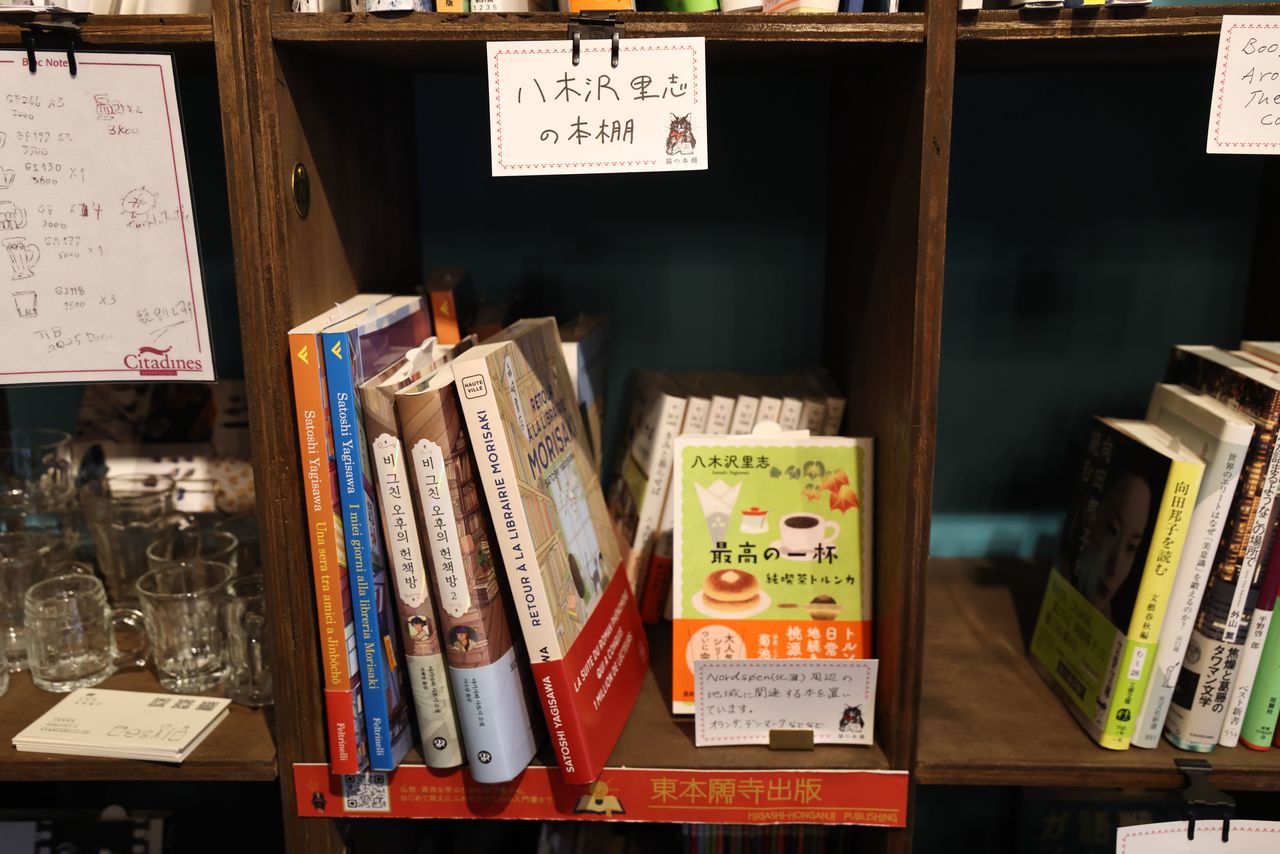
The interview took place at the Neko no Hondana Jinbōchō bookstore in Tokyo, (above) where people can rent shelves as their own little “shops” in which to sell books of their choice. Yagisawa’s shelf (below) contains translations of his books in different languages. (© Hanai Tomoko)
Yagisawa’s popularity in the West has been revived by his 2022 version Days at the Morisaki bookstore in Italian. The following year, an English translation was published, translated by Eric Ozawa; so far more than 600,000 copies have been printed. In 2024, it was nominated for the first book of the year at the British Book Awards, and in March of this year, Yagisawa was invited to the London Book Fair.
Although he has become a successful writer around the world, the road here was not easy. It was only after the COVID-19 pandemic that overseas popularity led to his “rediscovery” in Japan.
Tokyo’s Book District, Jinbōchō
Days at the Morisaki bookstore it was originally published in Japanese by Shōgakukan in 2010, and a film adaptation was released the same year. After the main character Takako is heartbroken by a co-worker and quits her job, she starts working at her uncle’s modern Japanese bookstore in Tokyo’s Jinbōchō district, which is famous for its many used bookstores. Here he rebuilds his life by meeting books and people around him. Yagisawa was inspired by his relationship with Jinbōchō.
“I had a job as a writer at an editorial production company in Kanda, and after work I would always go home and pass the district’s used bookstore.
After falling in love with Jinbōchō as a high school student, Yagisawa visited frequently while at university studying screenplays. He was always busy shopping for books related to screenplays and movies, as well as spending time in restaurants, including the old established Sabouru, which became the model for the cafe in his book.
“You can look at old books, and there’s a type of coffee shop that I like with the old charm,” says Yagisawa. “Before we got married, my wife worked at Jinbōchō bookstore. Since he enjoyed the latest literature, I started reading it too. That may have influenced the setting of my book.”
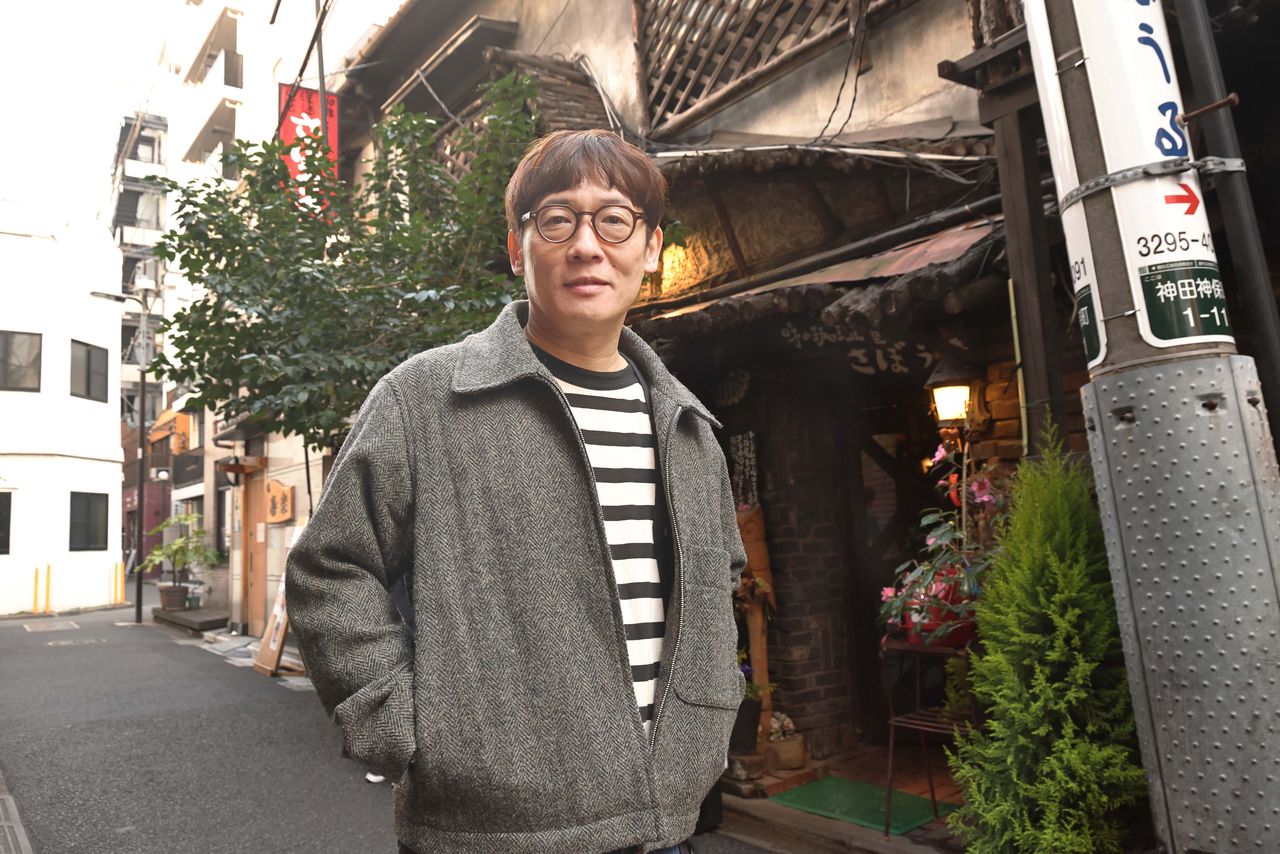
Yagisawa outside the Sabouru cafe. (© Hanai Tomoko)
Painful Time
Yagisawa had taken the first step, but he was still far from becoming a bestselling author. He published a sequel Many Days at Morisaki Bookstore, Days to eat at Torunka Café set in Tokyo’s Yanaka district, and I Don’t Live With You (not yet translated into English) about two siblings who found a lost cat, but sales were disappointing.
“Work-based fiction was popular at the time, and there was a need for a dramatic worldview,” says Yagisawa.
He lost all hope after receiving several hurtful comments, and stopped writing new books for many years. He even had a panic attack while trying to write. During this time, he read a lot in philosophy and psychology, trying to find anything that could help him recover even a little.
“This was the saddest moment of my life. I went to the bottom of my heart.
Days at the Morisaki bookstore received its first translation into traditional Chinese for the Taiwan edition. Taipei Ambassador Emily Chuang, who helps facilitate translations of books from many countries, played an important role in the rapid spread of Yagisawa’s book in the West.
“Emily read the Taiwan edition and seemed to like it very much.” Being a global distribution agent, especially for Europe and North America, everything went smoothly from there. as if it were happening to someone else.”
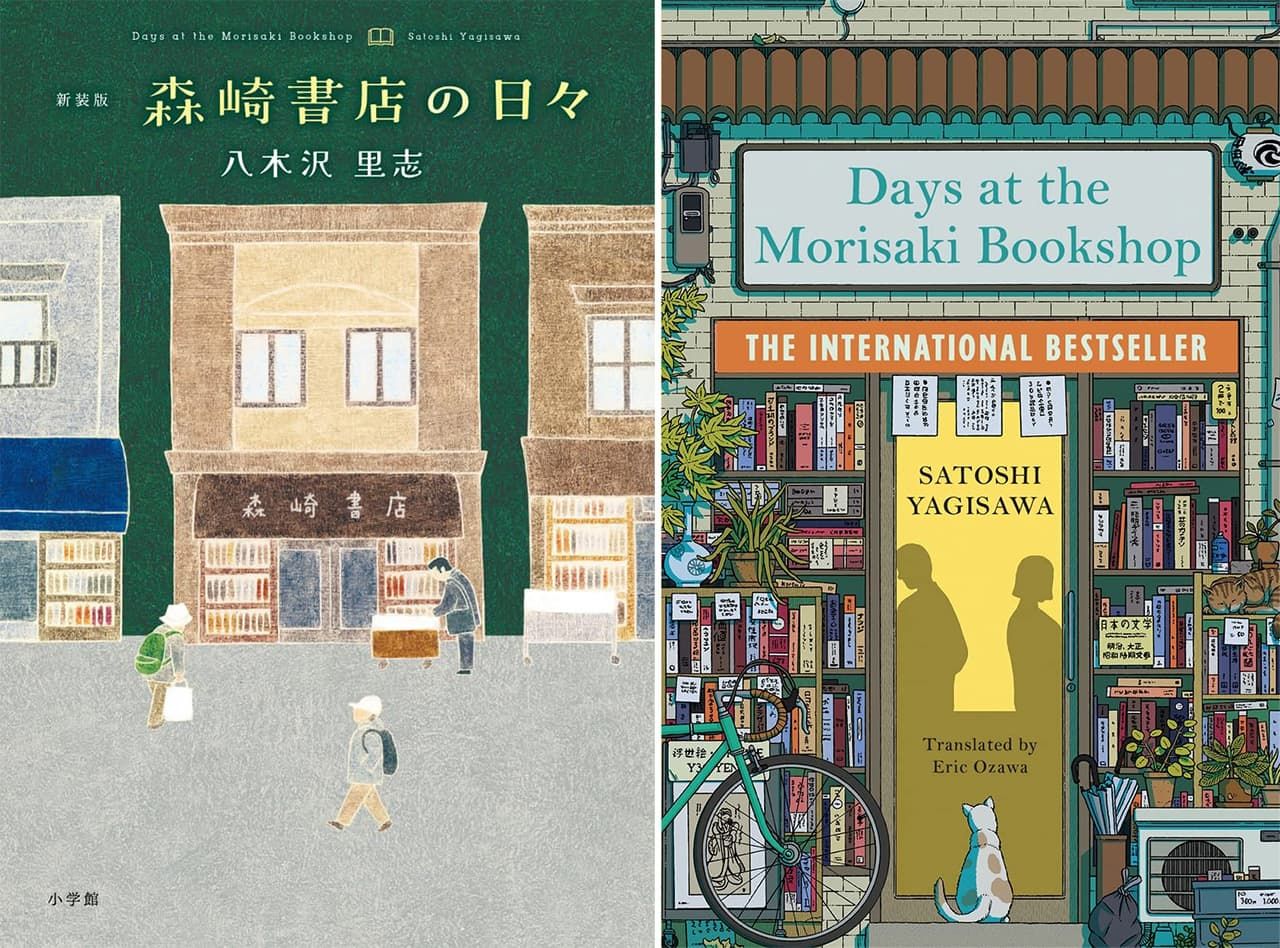
The 2025 edition of Morisaki’s first Japanese uncut hibi (left) and its English translation date at the Morisaki Bookstore. (© Shōgakukan)
Place of Presence
Yagisawa says: “My novel, which was described as ‘obscure,’ became popular overseas during the epidemic, and people started reading it in Japan.” Maybe everyone felt tired.
According to Shōgakukan, Japanese books about cats have long been popular overseas. Another article from the same house—Cat That Keeps Bookswritten by Natsukawa Sōsuke in 2017—is set to be translated into 40 languages, including many that have already been completed. Since the beginning of this epidemic, the demand is rising for what is known as “healing” or “good legend”, and the pioneers include. Kamogawa Food Explorers written by Kashiwai Hisashi in 2013 (translated into 30 languages) and Days at the Morisaki bookstore.
“It’s often called a ‘healing’ book, but at first I didn’t set out to write that kind of book. But I like to write when I feel close to the characters, as if I’m comforting them.
Whether it’s the Jinbōchō bookstore, the Yanaka cafe, or the guesthouse in Tochigi’s Nasu Highlands—it’s like home. Pension Wakeattepublished in February 2026 in Japanese—Yagisawa’s books are mostly about specific places, showing relationships between local people. Although the characters show consideration for each other, they do not overstep their boundaries, maintaining an appropriate distance.
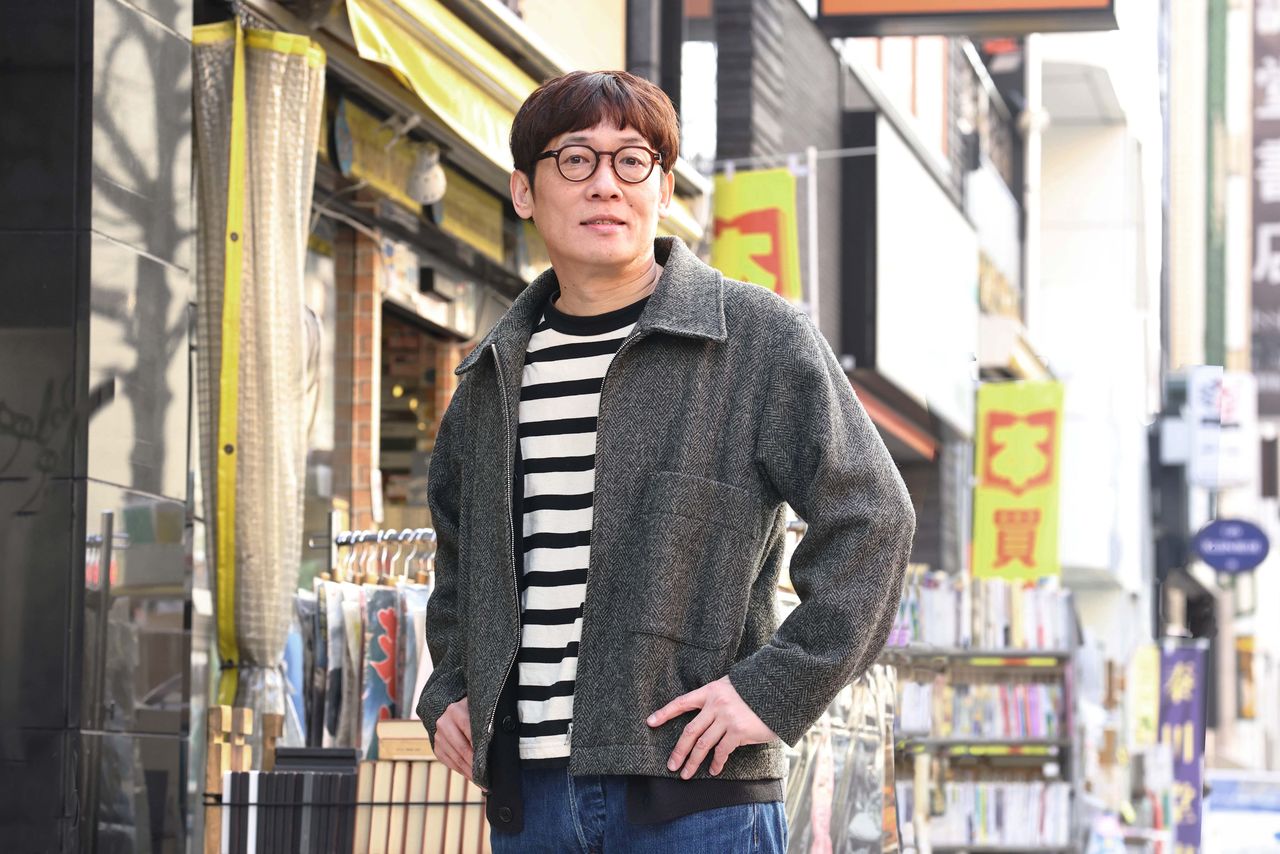
In the streets of Jinbōchō. (© Hanai Tomoko)
“Basically, I put my books in the places I like,” Yagisawa says. “Maybe this is because deep down, I value the feeling of being important. I grew up in a dysfunctional family, and home was not a place where I could be comfortable, so when I was young, I was looking for a place where I could.
I think about new settings in my daily life, for example, that I like to put a book in the cinema.
Dates with Cats
Japan, two Morisaki bookstore the books were published in new editions in 2025. Days to eat at Torunka Café it also had a new edition after the outbreak, before Yagisawa finished the trilogy in 2024; the first of this series is published in English towards the end of 2025. Several language translations for Pension Wakeatte they were confirmed even before it went on sale.
Yagisawa values his daily life, and he didn’t let this provocative situation ruin it. He found a special place to be with his wife and two rescue cats.
“Cats live with you, and they don’t force themselves. Another part of me needs that space. When I write books, again, I want to do something light but deep, not forced. Readers are sensitive so they will immediately see if I try to force messages on them, telling them to ‘cry’ or ‘feel healed.’
The daily life that we take for granted can be at risk – everyone has noticed that since this pandemic, and the uncertainty of international events has increased our anxiety. Yagisawa’s books about the precious everyday lives of ordinary people will no doubt continue to find readers in Japan and around the world.
Reference Works
All of Yagisawa Satoshi’s works translated into English so far are translated by Eric Ozawa.
- Morisaki was not shot is translated as Days at the Morisaki bookstore
- Zoku Morisaki shoten no hibi is translated as Again Days at the Morisaki bookstore
- Torunka in Junk is translated as Days to eat at Torunka Café
- Shiawase no kaori: Junkissa Torunka is translated as Other Days Torunka Cafe: The Smell of Happiness (to be published in 2026)
- I’m sorry (If I Live With You) and Pension Wakeatte (Pension Wakeatte) are not converted
- Hon o mamoro ho suru neko no hanashi by Natsukawa Sōsuke translated as Cat That Keeps Books by Louise Heal Kawai
- Kamogawa Shokudo by Kashiwai Hisashi is translated as Kamogawa Food Explorers by Jesse Kirkwood
(Originally written by Kimie Itakura of Nippon.com and published in Japanese on March 24, 2026. Banner photo: Yagisawa Satoshi with translations of Days at the Morisaki bookstore in various languages at the Neko no Hondana Jinbōchō bookstore in Tokyo. © Hanai Tomoko.)
#Yagisawa #Satoshi #Interview #Dates #Morisakis #Bookshop #Author #International #Dealer